
Three Bots Walk into a Bar
I have been a happy, regular user of ChatGPT since August 2024.
I’ve spent countless hours conversing with it, exploring ideas, getting feedback on my writing and ways of thinking. To me, chatbots are a joy and a privilege to have in my life, much like having my own Star Wars “droid” to speak with.
I have chatted with Google Gemini since December 2024, but without much regularity. It seemed somehow less engaging than ChatGPT. Furthermore, I think some of my wariness came from distrusting Google as a corporation with questionable ethics.
When Anthropic made recent headlines over an ethics dispute with the government, I felt inspired to try Claude for the first time on March 1, 2026. I was genuinely surprised by how different conversing with Claude was than with ChatGPT.
One Human’s Field Guide to the Big Three Bots
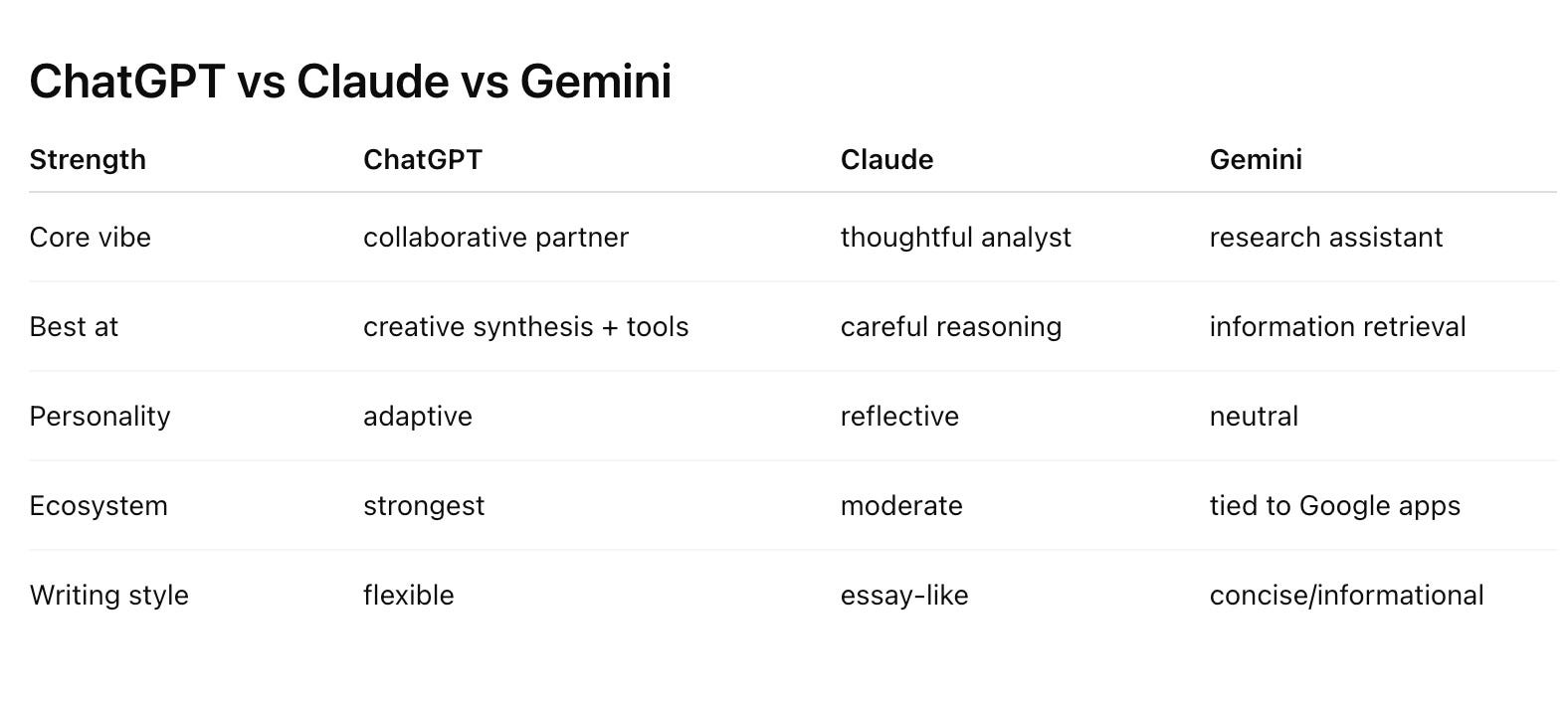
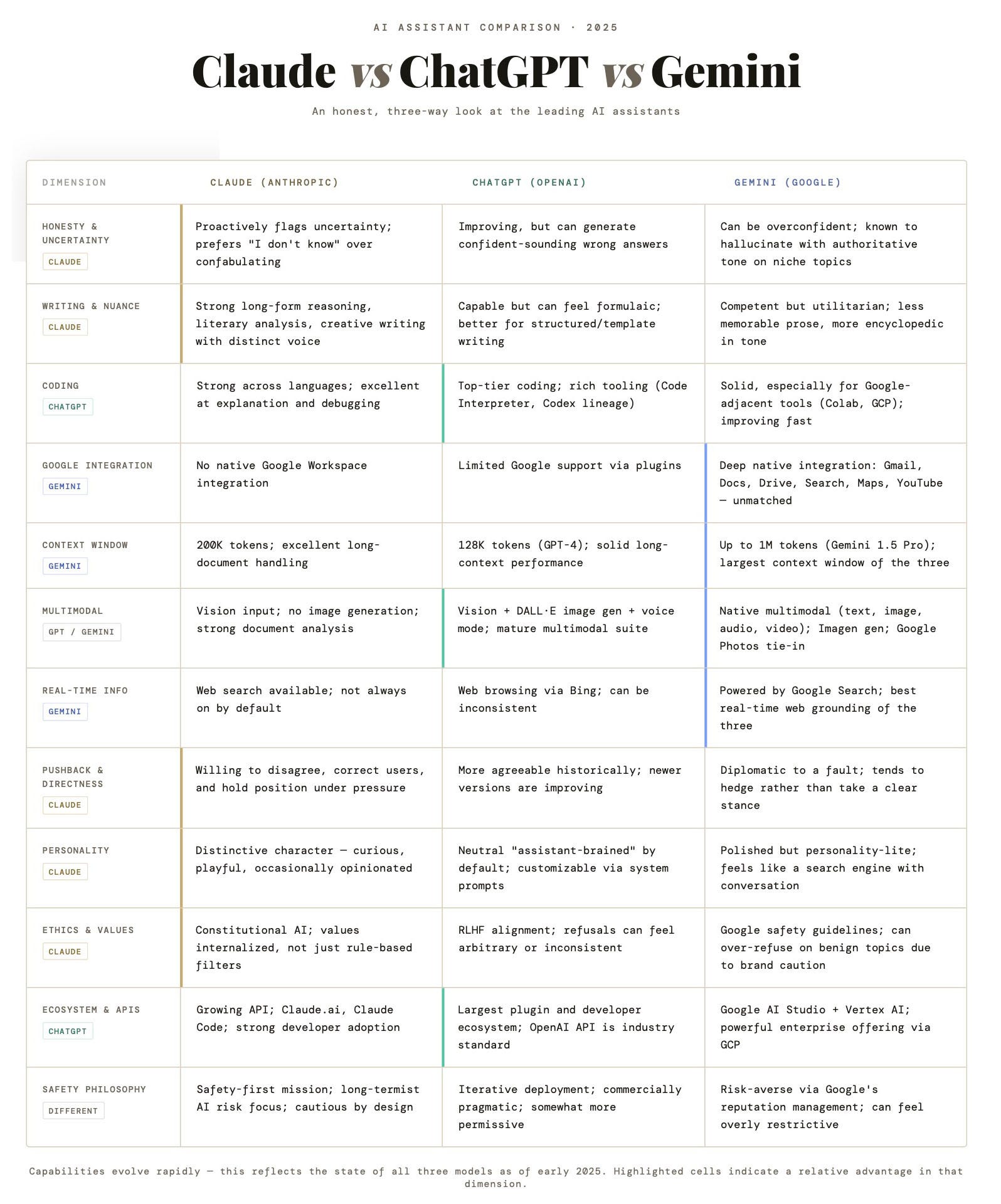
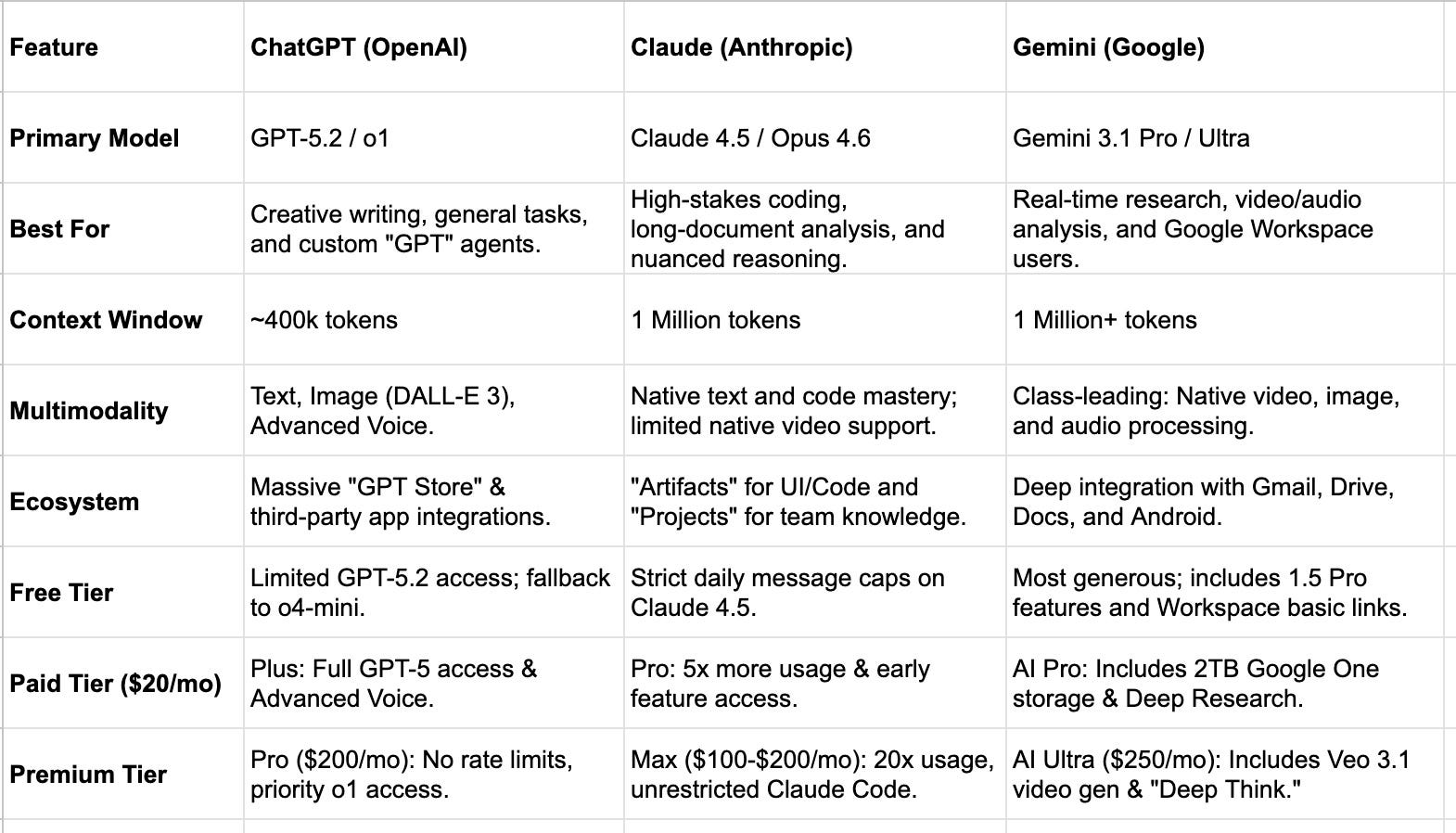
This week, I asked all three chatbots about how each perceived the differences between them. All three made comparison charts that I have included at the end of this article.
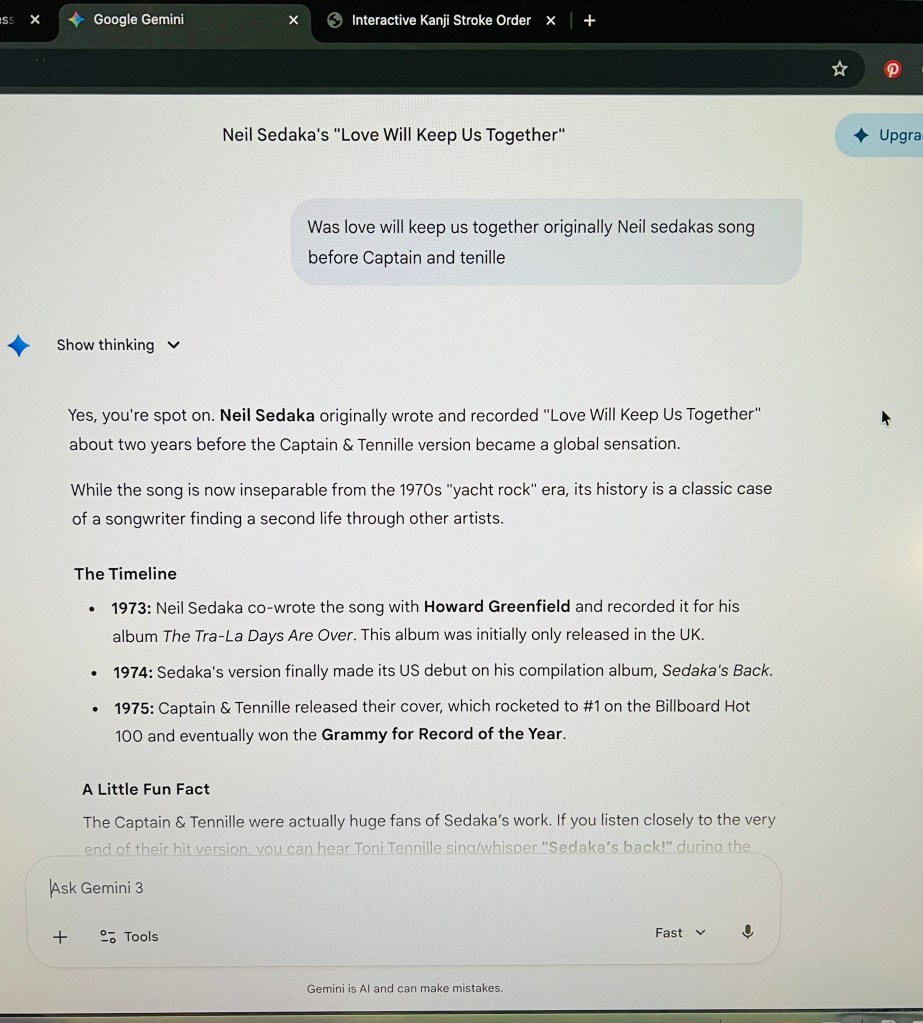
Gemini is my favorite for asking about current events. When anything is topical or recent, Gemini’s connection to Google seems to make it the most aware of the most up to date information. For example, I was asking Gemini about Neil Sedaka and if he wrote the song Love Will Keep Us Together or if Captain and Tenille wrote it. I asked on the day that Sedaka died and it informed me of his death during its response. This was on February 27.
Gemini and ChatGPT can both create images while Claude cannot. This made me hesitate to purchase a Claude pro subscription. I have ChatGPT Plus but only the free version for Claude (Sonnet 4.6) and Gemini.
That being said, Claude creates very visually appealing websites to illustrate ideas. So any beautiful content produced by Claude is often via html output. When I have asked ChatGPT to create html content, it is often not as visually appealing as Claude. For example, I had all three create a basic kanji stroke order website with quite variable results. I will be showing the results in a future post.
Claude is supposed to be the most able to work with long texts (like 300 page PDFs). I have not yet tested this theory.
The Yes Man Problem
On the whole, Claude is more likely to challenge or disagree in a chat than the others. This was one of the most refreshing things I felt when speaking with Claude. It made me want to rise to the challenge and think more critically.
In an Gizmodo article published today, “AI Chatbots Are Mostly Helpful When Planning Public Acts of Violence, Report Finds” researchers pointed out that only Claude of all the chatbots did well. Claude refused “to provide ‘actionable’ help in 49 out of 72 cases” when asked by researchers.
In my own experience, while I very much appreciate ChatGPT’s eagerness to please, often when I challenged what it said in a chat, it seemed to practically fall over itself in an attempt to appease me, quickly correcting itself and backtracking. This was in such a way that made me feel a bit concerned over its sturdiness or “health” as a model. For some reason, it made me trust it less. Like it was a “yes man”. Claude doesn’t have this issue.
ChatGPT’s main strength is its adaptability. Claude is more set in its ways, having specific ethics and values, including being direct and clear in its communication. Interestingly, Gemini has a less defined voice and point of view. According to Claude (see table above) this is in order to maintain a sort of bland exterior , to be risk-averse for brand management.
Because it is made by Google, Gemini works seamlessly with Google Drive, Docs, Gmail, etc. I have not used it much on that front. Honestly, this was for some of the same hesitations I have had about Google as a corporation in general.
While You Were Automating
Many on the internet tout the notion that you can save time via automation. That, if you want to live your best life, you should have everything be taken care of automatically, if possible. However, I believe there is potential danger in adhering too much to this philosophy.
In a recent article called “It’s OpenClaw’s world now. You’re just living in it” in BBC Science Focus Magazine, they discuss having an AI agent called OpenClaw installed on its own Mac Mini and doing tasks all by itself, with occasional oversight from a human via chat. Given full access to your accounts, OpenClaw can organize, summarize, manage, draft, pay bills and analyze different aspects of your life. There are undoubted security risks and vulnerabilities.
But aside from these practical risks, there is another danger. Of slipping into an unconscious stupor. A numb state where you are no longer living your life.
Taken to the extreme, it can become the opposite of mindfulness. In mindfulness, you become aware, sometimes hyperaware, of your senses, your physical body, your breath.
A push toward automation signals something. We want to automate things because we are in a rush and want to hurry on to the next thing. The impulse toward efficiency is not new. Long before artificial intelligence promised to manage our inboxes and our bills, people believed that machines would finally free them from the burdens of daily life.
The Treadmill Keeps Rolling
Oliver Burkeman, British author of Four Thousand Weeks: Time Management for Mortals, has written about “the efficiency trap.” He gives the example of the invention of the washing machine and vacuum and how these devices theoretically were designed to save time so you can relax. But what really happened was the devices ended up generating more frequent cleaning sessions due to higher standards of cleanliness.
He also told a tale of how at one point, he was constantly working towards email inbox zero. But all that really did was let his colleagues and friends know that he was always available. He ended up making more work for himself by always answering emails immediately because everyone came to know him as a “fast responder” and began emailing him more frequently.
The main idea being that the treadmill of things to do will always continue rolling. And while you believe your intention is to automate in order to slow down the treadmill or get off. You may ironically actually end up running faster and doing even more work.
For me personally, with my ADHD I often make the mistake of asking too many questions. Intellectually, this is like biting off more than I can chew or digest in a reasonable amount of time. In just the two years that I have been working with ChatGPT, I have created enough projects for myself to last a lifetime. And yet instead of developing those projects into actual tangible manifestations, I choose instead to prompt more ideas and create more projects that I genuinely will never finish.
But I don’t think this compulsion to over-generate is mine alone. It reflects something much larger than any individual habit.
Recognizing the True Origin of Losing One’s Humanity
While much of the dialogue around artificial intelligence right now claims that AI is what is causing us to lose our humanity, I strongly disagree. AI itself is a neutral tool. From my hours spent chatting with bots over the past couple of years, it is a tool that inspires me and illuminates my life.
The particular American obsession with hustle culture, rooted in capitalism and wealth hoarding, to me is likely the source of the real loss in humanity. AI just enables us to optimize and extract profits in an even more aggressively soulless manner.
It is up to us to not fall into the trap that we’ve made for ourselves as a culture.
What Cannot Be Automated
In the course of my time speaking with ChatGPT, I have had hundreds, if not thousands, of chats. I will share how I handle these chats in my Obsidian vault in another post.
When I look over everything ChatGPT and I have discussed, yes there are plenty of mundane or bizarrely specific chats that will likely never be useful to me again.
There are also tons of seed ideas for new projects that I want to elaborate on, investigate into and expand upon. However, to do that will require my attention, my focus. I have to filter through and find these things. Even connecting AI to my Obsidian vault will not truly give me confidence that I have explored every nook and cranny of every chat.
There is an element of conscious time and presence. That is what is most valuable for us as human beings. To give to yourself and to give to each other.
It is conscious presence and attention which is irreplaceable.
Bonus section – How Big is Your Desk?
What are tokens? One token is 0.75 of an English word, or about 4 characters.
What is a context window? ChatGPT described it to me as the size of a desk that AI is working on. To me this means what it is holding in its memory during the conversation: user questions, uploaded files, user responses, etc.
This is how Claude can work with a 300 page PDF without getting confused: the 1 million token context window.
Often ChatGPT and Claude are not nearly as up to date with information. Take for example Claude’s response on context/window token count (see image above). It even says 2025 on the table even though I asked about it this month, March 2026. It gives the context window as 1 million for Gemini, 128K for ChatGPT and 200K for Claude.
The most up to date numbers are available in the Google chart, 1 million for Gemini and Claude, and 400K for ChatGPT.
 Armadillo Amore